
School of Nursing & Health Sciences · Graduate program
Master of Science in Nursing: Nurse Educator
Shape the next generation of nurses.
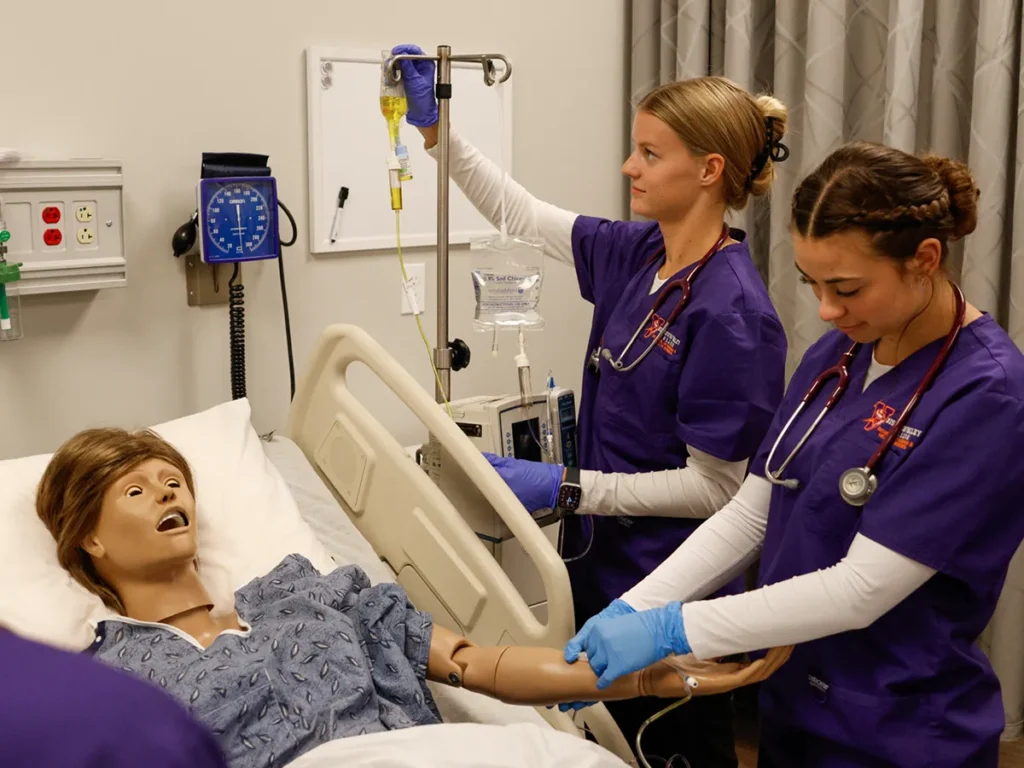
You love nursing, and you love helping others learn it. MVU’s online MSN–Nurse Educator track helps you build the teaching, curriculum, and leadership skills to educate nurses in the classroom, in clinical settings, and online.
38
credit hours
100% online
coursework
3 terms
spring, summer, and fall
3
practicums: 2 teaching, 1 clinical
Working nurses
the track is designed for you
6 states
RN licenses accepted
Why MVU for nursing education
Grow into the educator role, on your schedule
An online track for working nurses who want to teach, mentor, and lead.
Built for working nurses
Coursework is 100% online, so you can balance school with work and personal life.
Learn how to teach
Courses in instructional strategies, assessment, and curriculum development prepare you for the educator role.
Teach in real settings
Two teaching practicums and a population-health clinical practicum put your new skills to work.
Lead change
Use leadership skills, technology, and data to improve education and population health outcomes.
An accredited MSN program
MVU’s MSN program is accredited by CCNE. The Nurse Educator track is in CCNE’s approval process. See accreditation.
Is this program for me?
The Nurse Educator track may be a great fit if you want to…
- Teach and mentor nursing students or new nurses.
- Move into an education or practice leadership role in inpatient or outpatient settings.
- Earn your MSN online while you keep working.
- Help prepare the next generation of nurses.
What will I learn to do?
Skills you’ll practice and grow
- Use evidence-based teaching strategies in classroom, clinical, and online settings.
- Create, evaluate, and improve nursing curriculum and programs.
- Assess and evaluate learners fairly and effectively.
- Lead change with leadership skills, information technology, and data.
- Bring research and best evidence into education and practice.
School of Nursing mission
The mission is to advance the art and science of nursing through innovative teaching, research, personal instruction, and clinical practice. To educate and train diverse groups of nursing professionals to interact with interdisciplinary teams thus promoting optimal health outcomes in individuals, families, and global communities while promoting a culture of lifelong learning.
Program learning outcomes
The MSN is built on the 10 domains of professional nursing practice defined by the American Association of Colleges of Nursing (AACN). By graduation, you’ll meet the expected competencies in each domain:
- Knowledge for Nursing Practice
- Person-Centered Care
- Population Health
- Scholarship for the Nursing Discipline
- Quality and Safety
- Interprofessional Partnerships
- Systems-Based Practice
- Informatics and Healthcare Technologies
- Professionalism
- Personal, Professional, and Leadership Development
MSN program goals
The goals of the Master of Science in Nursing program are to:
- Advance the education for the baccalaureate prepared nurse to serve in leadership roles in practice setting, advanced nursing practice, nursing education, and/or administrative roles.
- Prepare graduates for advanced practice nursing to meet the healthcare needs of diverse populations (individuals, families, groups and communities) in multiple health care settings such as primary care, hospital inpatient/outpatient, managed care organizations, and governmental organizations.
- Prepare nurse practitioners qualified and dedicated to provide culturally sensitive and competent primary health care to diverse populations across the lifespan, locally, nationally, and around the globe.
- Use research-based/ best practices from nursing and other disciplines to advocate for policy changes that will improve the health outcomes of individuals, families, communities, and aggregate populations.
- Promote a systems perspective to deliver high quality, cost effective, and safe care by working collaboratively with organizational leadership.
- Prepare nurse educators to transition into academic or clinical teaching roles thus helping students and nursing staff to think critically and use best-practices while maintaining competence in delivering patient centered care in diverse settings.
Your path
From expert nurse to nurse educator
You strengthen your advanced nursing knowledge, learn how to teach it, and then practice teaching with support.
01
Advanced nursing core
An MSN orientation, then advanced pathophysiology, pharmacology, and health assessment.
02
The educator role
Step into the nurse educator role and learn instructional strategies that work.
03
Curriculum and evaluation
Design curriculum, evaluate programs, and assess student learning.
04
Practicums
Two teaching practicums plus a 30-hour clinical practicum focused on population health.
05
Capstone
A nurse educator capstone project brings it all together.
Where can this degree take me?
Teach where nurses learn and work
Nurse educators create learning environments for diverse learners, in the classroom and online, in settings like these.
Nursing education programs
Hospital inpatient settings
Outpatient settings
Online and distance learning
For current pay and job outlook, see the U.S. Bureau of Labor Statistics guide to postsecondary teachers, including nursing instructors.
About accreditation. MVU’s MSN program is accredited by the Commission on Collegiate Nursing Education (CCNE). The Nurse Educator track is in the process of CCNE approval. Learn about MVU’s accreditation.
Affording your degree
Plan your investment
Tuition is charged per credit hour, and there are several ways to help pay for it.
Tuition
$500 per credit hour for 2026–27, plus a $200 enrollment fee each academic year. See tuition and fees.
Program costs
Some courses carry lab or material fees, and you’ll provide your own liability insurance. Course fees are listed in the catalog.
Financial aid
Graduate students may qualify for federal loans and other aid. Start with Tuition & Financial Aid.
Explore the curriculum
38 credit hours, step by step
Most courses are 3 credit hours; others are noted. You build your advanced nursing core, learn to teach, and finish with practicums and a capstone.
Course descriptions and requirements in the catalog →
Program handbooks
Your handbooks explain program policies, clinical requirements, and what’s expected of you as an MSN student. Not sure which year applies to you? Ask the MSN Director.
- 2026–27 MSN Student Handbook (Google Doc)
- 2026–27 MSN FNP–NE Clinical Handbook (Google Doc)
- 2025–26 MSN Student Handbook (Google Doc)
- 2025–26 MSN Clinical Handbook (Google Doc)
Advanced nursing core (10 credit hours)
- NURS 500 Orientation to MSN (1 credit)
- NURS 510 Pathophysiology for Advanced Nursing Practice
- NURS 520 Pharmacology for Advanced Nursing Practice
- NURS 530 Advanced Health Assessment
Nurse educator role and teaching (15 credit hours)
- NURS 555 Transitioning to the Advanced Practice Nurse Educator Role
- NURS 505 Instructional Strategies in Nursing Education (4 credits)
- NURS 515 Evaluation & Assessment in Nursing Education (4 credits)
- NURS 525 Curriculum Development and Program Evaluation in Nursing Education (4 credits)
Leadership and research (6 credit hours)
- NURS 535 Using Leadership Skills and Information Technology to Lead Change and Improve Population Health Outcomes
- NURS 545 Research & Best Evidence for Educational & Clinical Practice
Practicums and capstone (7 credit hours)
- NURS 565 Teaching Practicum I (1 credit)
- NURS 575 Teaching Practicum II (2 credits)
- NURS 585 Clinical Practicum III (30 hours, population health focus) (1 credit)
- NURS 595 Nurse Educator Capstone Project
Ready to take the next step?
Applying is simple
Four steps from application to your first course.
01
Apply online
Complete the free online application for MVU and the Nurse Educator track.
02
Send transcripts
Have official transcripts from every college you’ve attended sent to admissions@moval.edu.
03
References and review
Submit two professional references. Nursing faculty review your transcripts and build your plan of study.
04
Background check
Once you’re admitted, complete a criminal background check before your first semester of nursing courses.
Admission requirements
- A current, unencumbered registered nurse (RN) license in Missouri, Oklahoma, Illinois, Kansas, Iowa, or Arkansas. If you’re licensed in another state, your eligibility to teach is governed by your State Board of Nursing, so check with your board before you apply.
- A BSN from a nationally accredited program, with a grade of B or higher in all nursing courses and clinicals.
- A cumulative GPA of at least 3.0 (on a 4.0 scale).
- Official transcripts from all colleges and universities you’ve attended, and a transcript review with an academic plan of study.
- Two professional references.
- A satisfactory criminal background check before your first semester of nursing coursework.
- The School of Nursing Faculty Committee reviews every application. If you don’t meet the criteria, the Program Director, Associate Dean, or a designee will let you know by letter.
Deadlines
- Spring (January–May): apply by December 1.
- Summer (May–July): apply by April 1.
- Fall (August–December): apply by July 1.
- Late enrollment may be allowed if space is available, and a late fee may apply.
Transfer credit
- If you completed Pathophysiology, Pharmacology, and Advanced Health Assessment for Advanced Nursing Practice in the last five years with a B or higher, you may transfer up to 9 credit hours. These courses are also offered in the program.
Is the program online?
Yes. Coursework is delivered 100% online. Your teaching and clinical practicums are completed in approved settings.
When can I start?
Courses are offered in the spring, summer, and fall semesters. Talk with the MSN Director about the best start for you.
Which RN license do I need?
A current, unencumbered RN license in Missouri, Oklahoma, Illinois, Kansas, Iowa, or Arkansas. If you’re licensed in another state, your eligibility to teach is governed by your State Board of Nursing, so check with your board before you apply.
Is the track accredited?
MVU’s MSN program is accredited by CCNE, and the Nurse Educator track is in the process of CCNE approval. See MVU’s accreditation.
How is this different from the FNP track?
The Nurse Educator track prepares you to teach and lead in nursing education. The Family Nurse Practitioner track prepares you to provide primary care as a nurse practitioner.
Can I transfer graduate courses?
Pathophysiology, Pharmacology, and Advanced Health Assessment for Advanced Nursing Practice (up to 9 credit hours) may transfer if completed in the last five years with a B or higher.
Talk with the MSN Director
Have questions about the track, scheduling, or admission? Reach out. We’re happy to talk through your goals.
MSN – Nurse Educator